2025 Award Futures Bets & Predictions
At the time of writing, we are one week from Opening Day, so to handle the anticipation, let's preview the MLB award future props by covering the MVP, Cy Young, and Rookie of the Year markets.
These markets are quite vast and offer long odds for players outside of the group of favorites. In years past, we've seen plenty of cases where a long shot has a statistically unexpected year as they skyrocket to the crown. Just last season, we saw Jackson Merrill of the San Diego Padres narrowly miss out on cashing a 40/1 Rookie of the Year ticket. With heavy favorites at the top, especially in the case of Shohei Ohtani in the NL MVP race, it leaves plenty of breakout candidates with valuable odds in the pack to choose from.
The important question is–how are these awards evaluated, and what should we look for in a breakout candidate aside from the perceived value in their odds?
MVP: What Constitutes a Winner?
Per Action Network's Sean Zerillo, here's a detailed breakdown of what matters and what does not matter to MVP voters.
What Matters:
- Wins Above Replacement (WAR): Twenty-eight of the past 30 MVP winners (93%) ranked in the top three in WAR in their respective leagues. Twenty-one (70%) of those 30 winners finished as the league leader in WAR, including both Aaron Judge (11.2 WAR) and Shohei Ohtani (9.1) in 2024.
- OPS Ranking: Counts twice as much as a player's ranking in any counting stat (batting average, RBI, home runs, stolen bases) or team winning percentage. Every (offensive) MVP winner since 2001, except for Ichiro Suzuki, has had an OPS greater than .850, which generally limits the MVP's…
- Position: In the past two decades, two pure pitchers (Clayton Kershaw and Justin Verlander) have won MVP (three in 35 years). Outfielders and corner infielders have won more than 75% of the time, including 17 of the 20 most recent recipients (second baseman Jose Altuve and DH/pitcher Shohei Ohtani are the only exceptions). The WAR positional adjustment for middle infielders or catchers isn't enough to overcome superior offensive production.
What Does Not Matter
- Making the Playoffs: Twelve of the past 50 MVP winners (24%) failed to make the postseason. Perhaps more importantly, in 2022, none of the three finalists in either league made the postseason, the most dramatic shift in the history of MVP voting.
Inconclusive
- Teammates Competing for Votes: Since 2000, the closest teammates in MVP voting, relative to the actual MVP winners, have ranked around 10th, on average. Only one pair of teammates finished one-two — Jeff Kent and Barry Bonds in 2000. Five additional pairs have finished in the top three of voting, including Aaron Judge and Juan Soto in 2024. Five MVP winners finished with multiple teammates in the top 10, including Ronald Acuña Jr. in 2023 (alongside Matt Olson, 4th, and Austin Riley, 7th). Conversely, there are four instances where three teammates finished in the Top 10 without winning any awards, potentially stealing votes from one another.
Using the above criteria, we can generate a simulation (using a Monte Carlo method) that will evaluate each key metric and determine a projection of the implied likelihood that each player in the sim will win the award. From there, we can use the simulation's percent chance of winning to generate the fair betting odds and compare that to the market odds, which will identify which players have value.
You'll find results from the sim along with a comparison of first-half vs second-half KPI's for each respective award below. Let's dive in!
AL MVP
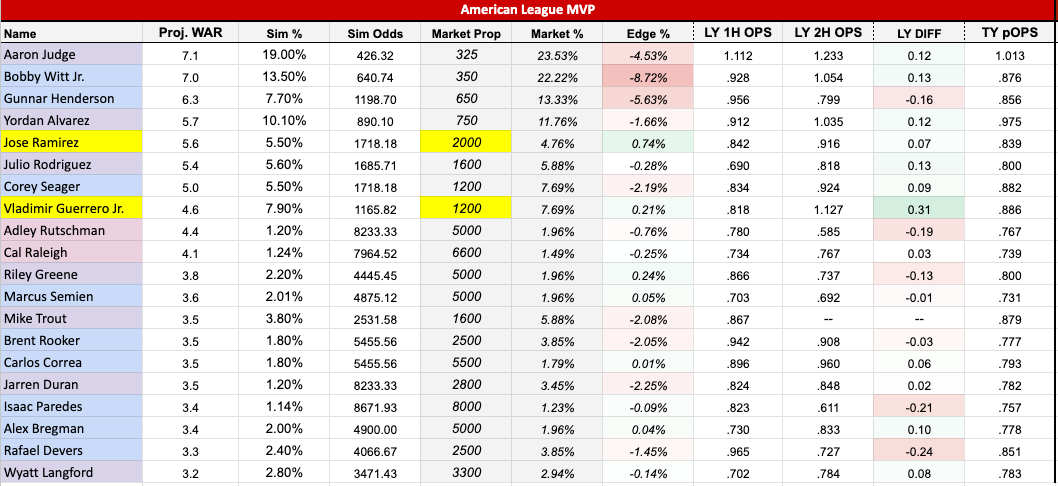
Let's start with an honorable mention because if all things were equal, I would back this guy to win the award–unfortunately, his price isn't right at the time of writing to invest with any sort of value.
Bobby Witt Jr. (+350): From a pure talent perspective, it's hard not to invest in Witt even at this short price, but the simulation does not render any value. His dominance with the bat and on the base paths while playing at a premium position makes him a heavy favorite, which is reflected in the price.
My favorite value pick is next...
Vladdy Guerrero Jr. (+1200): If you read my stat category projections blog, you know I'm high on Vladdy this season. His second-half breakout in 2024 shows his potential to improve in several areas, most notably in the power department. His OPS was 1.127 down the stretch while he reduced strikeouts and increased his walk rate. Now, in a pivotal contract year, if he can perform on pace with those second-half results, this is a good price to buy a guy who has already proven his ability to compete at an MVP level.
Although I am not high on the Guard Dogs this year, I really like the value on this next guy. Remember, we already determined that team success does not factor in heavily into the MVP vote.
Jose Ramirez (+2000): This is a guy who is as consistent as they come in the perennial all-star category. He's going to get on base, slug, and play stellar defense at a premier position every single year, along with hitting in the middle of the order from both sides of the plate. He's a safe bet, especially at these odds of 20/1. The simulation suggests he will win the MVP 5.5% of the time, given his projected WAR and OPS, which is higher than the implied 4.76% chance the market price implies.
NL MVP
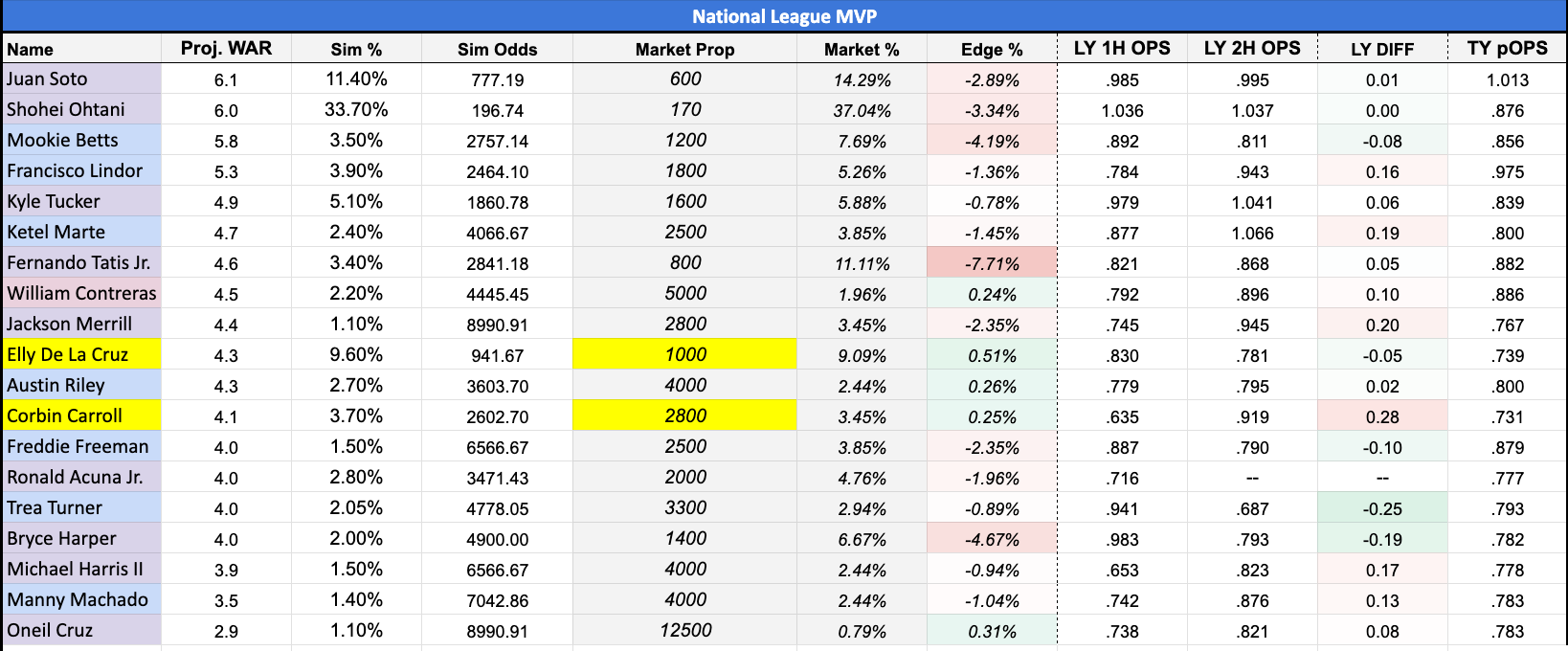
The price has moved after a hot spring training performance, but I still like Elly to skyrocket to the top of several charts this season. His new stance/approach at the plate should help him reduce the high strikeout rate we've seen from him in recent years, which should prove an increase in on-base percent–those combined mean more stolen base opportunities and more runs.
Elly De La Cruz (+900): With Ohtani atop this market as a heavy favorite, there's added value on the field. No other members of the field possess the high ceiling Elly has as a 5-tool player who is projected to compete for a triple crown (in some shape) - I love 2025 to see a breakout year.
As for more of a long shot with value...
Corbin Carroll (+2800) After a slow start to last season, there are signs that Carroll will see his level of play return to his 2023 form, where he finished 5th in NL MVP voting. His OPS increased in the second half, along with his ability to figure out the adjustments left-handed pitchers had made against him to start the year. His speed and defense provide an added boost to his WAR; those will always be there to prop him up. If he gets it going with the bat this year, this is a valuable price to buy at.
Cy Young: What Constitutes a Winner?
Historically, four basic statistics correlate most strongly to Cy Young winners: Wins, ERA, strikeouts, and WHIP.
However, there has been a clear upward trend regarding WAR and Cy Young winners in recent seasons, which mirrors the trend between WAR and MVPs.
Fifteen of the past 18 (83%) Cy Young winners have finished in the top three in their respective leagues in pitching WAR — the only exceptions being Blake Snell (7th in 2018 and 6th in 2023) and Robbie Ray (7th in 2021). Chris Sale (6.4 WAR) and Tarik Skubal (5.9) led their respective leagues in WAR in 2024.
AL Cy Young
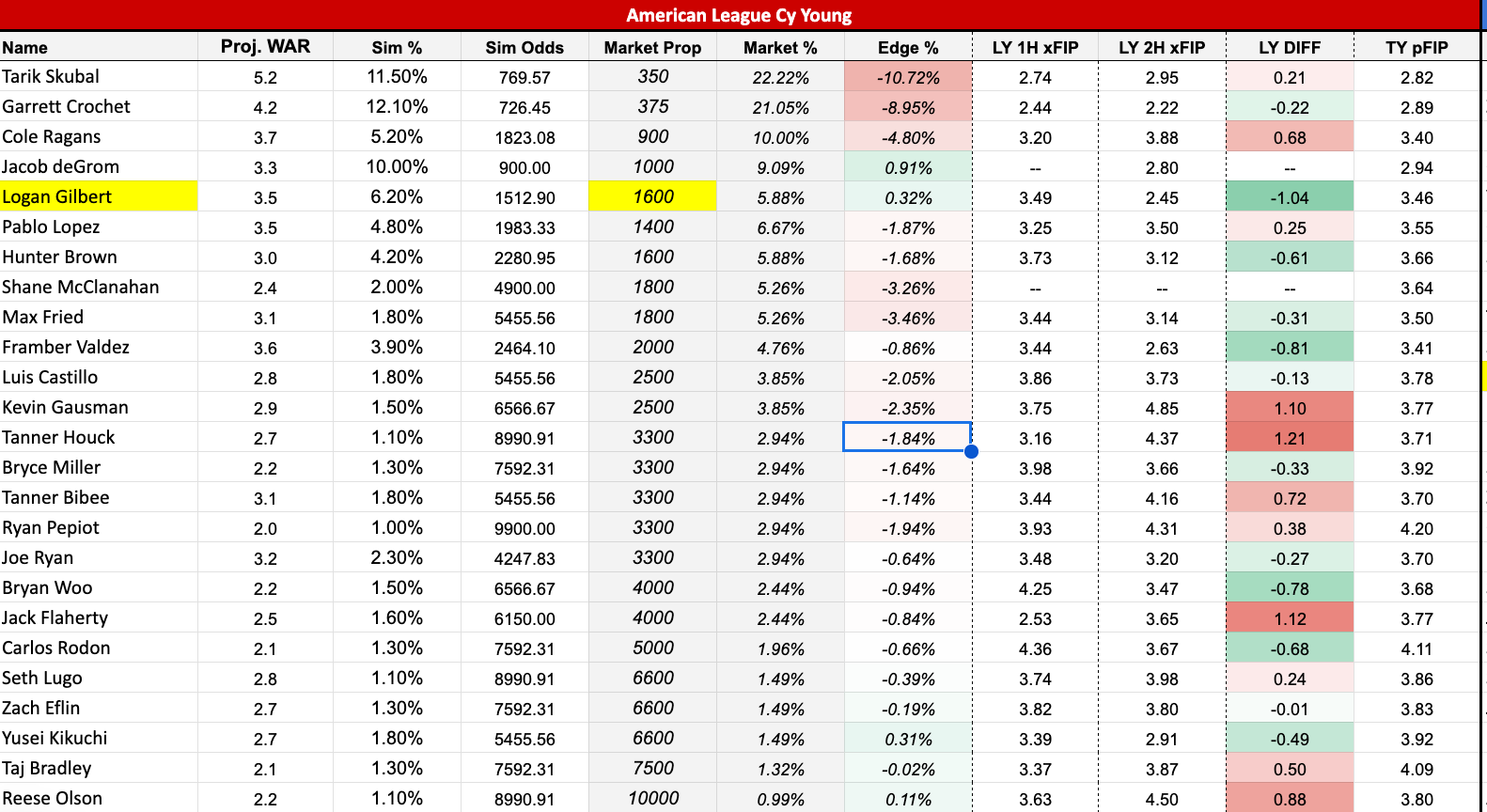
Overall, I do not see much value in the AL market at the time of writing. Jacob DeGrom, given his lofty projections based on historical dominance, shows slight value at 10-to-1 odds, but his recent struggles with health are enough to keep me off an investment.
Logan Gilbert (+1200) was dominant after making a key adjustment to his arm slot position, which resulted in an uptick in velocity, and an adjustment to his pitch mix using the fastball slightly less. These changes resulted in his ERA and FIP decreasing, while the K/9 rate increased, especially when you take a look at his splits in the first and second halves of 2024. I believe for these reasons, his price in the market has value compared to anyone else in the field. It's also worth noting (as I did in the stat projection blog), that his home starts at T-Mobile park offer an added advantage based on park factors–although the voters for this award take into consideration park-adjusted rates for ERA and FIP, this advantage could help boost his counting stats which are not adjusted for the park.
NL Cy Young
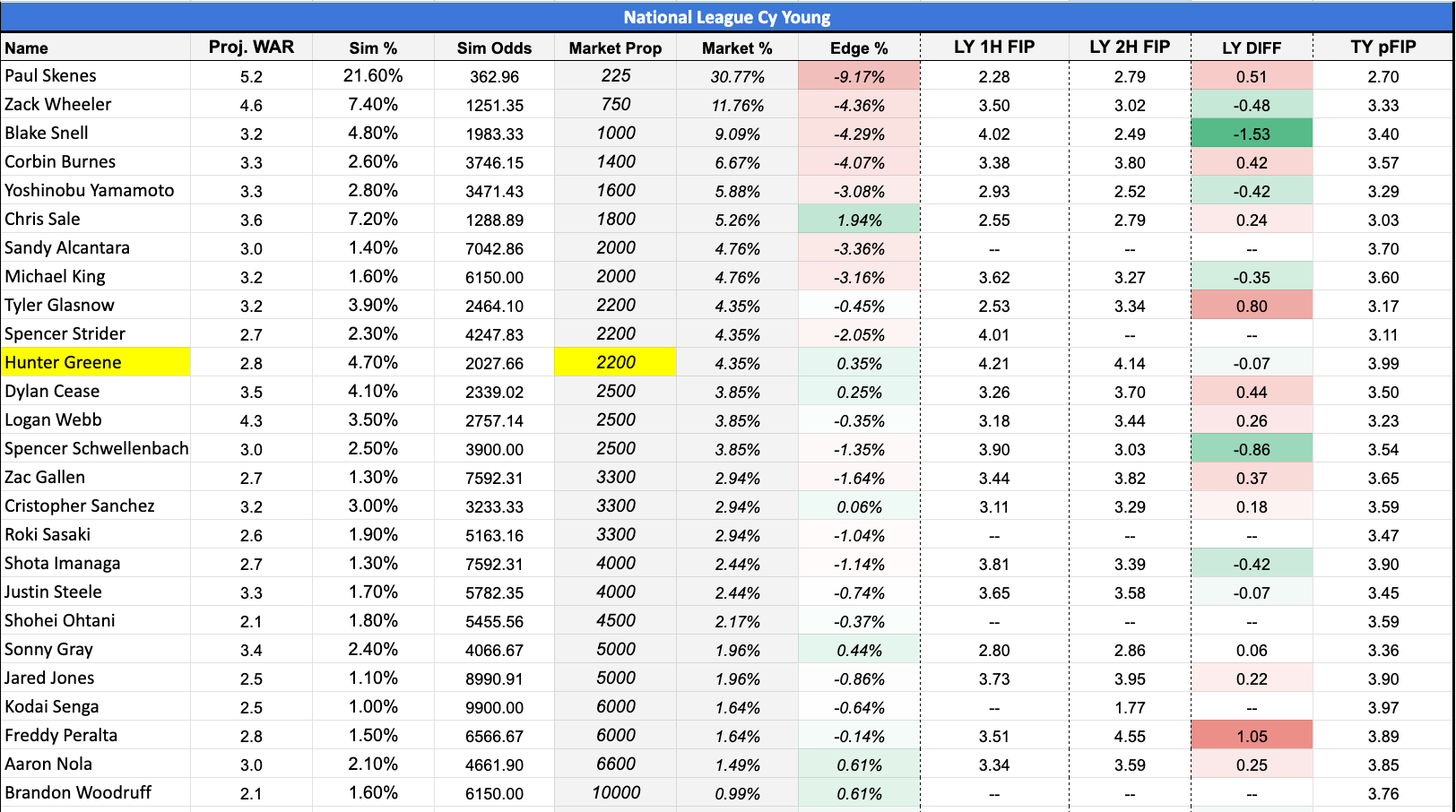
When you view this chart, the most obvious candidate that stands out under the "Edge%" column is Chris Sale of the Atlanta Braves. His WAR, FIP, and ERA projection combine to be a very compelling case for his Cy Young candidacy. However, given his injury history, I would prefer to refrain from investing here and go with a more up-and-coming star for the Cincinnati Reds.
Hunter Greene (+2200): Greene's effectiveness spiked in the second half of 24' and he's picked up this year where he left off, continuing to show dominance in spring training using his high velocity to strikeout a high rate of hitters. His ability to make adjustments to his fastball shape in recent years has continually increased his effectiveness. His "stuff" is electric, combined with his willingness to adjust to what hitters can pick up on, gives me confidence in investing at this very valuable price.
I also project the Reds to take a step forward as a team, which will help his case in this department as well.
Rookie of the Year: What Constitutes a Winner?
Before the 2024 season, a clear trend had emerged in Rookie of the Year (ROY) voting, towards typically rewarding the rookie hitter with the highest WAR total for the season. Eighteen of the 24 ROY winners (75%) between 2012-2023 finished atop the rookie leaderboard in their respective league in WAR, with an average ranking of 1.46 among the 24 award recipients (only skewed by the pandemic-shortened season in 2020)
However, a pair of pitchers (Paul Skenes, 2nd in NL WAR and Luis Gil, 8th in AL WAR and third among AL pitchers) earned top rookie honors in 2024, among a loaded class of debutants in both leagues.
Colton Cowser (led the AL with 4 WAR) finished in second with 13 first-place votes, while Mason Miller and Cade Smith, who both finished ahead of Gil in pitching WAR, each received a first-place nod, too. If Cowser were instead first on each of those relief pitcher-led ballots, he would win the award, and we continue to highlight WAR as the clear guideline for rookies moving forward; instead, we had an outlier result amid a clear recent trend.
Playing time and WAR should continue to be most of the equation for narrowing down the ROY field in the preseason. However, WAR potential — or average WAR as a component of playing time — is also worth assessing in case these rookies exceed preseason expectations of playing time.
Essentially, as bettors, we should be more open to investing in exciting young pitchers in this category than previously, based on the notoriety.
AL Rookie of the Year
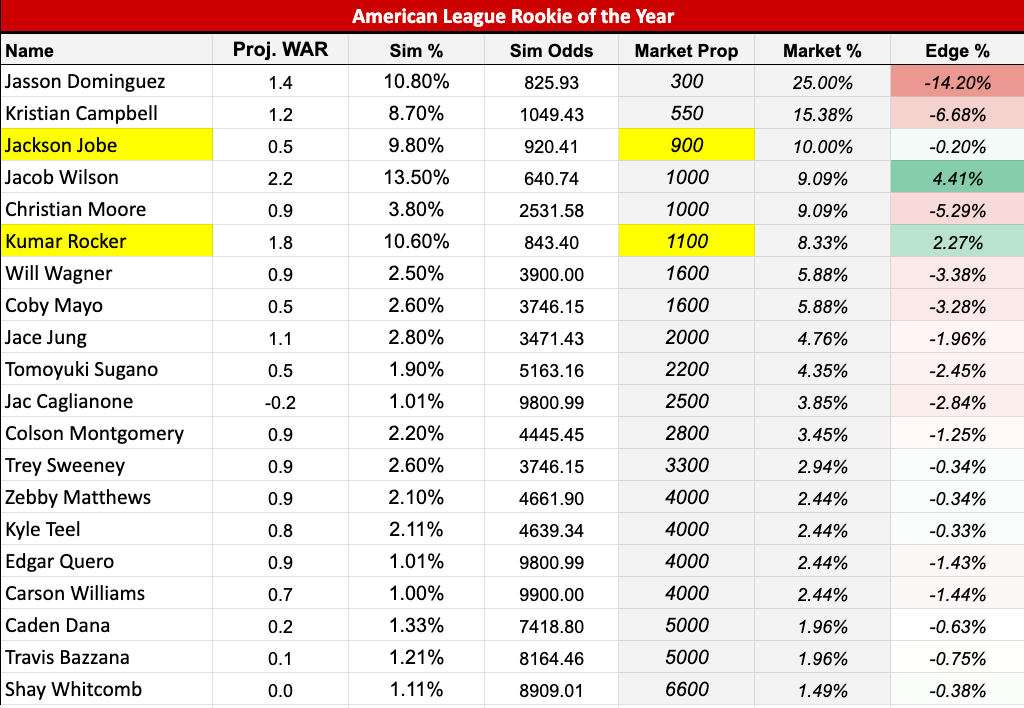
At the time of writing (two days before opening day), the pieces are seemingly coming into place as rosters are finalized and members of this market are solidified as in or out of the big league mix. Notably, Jasson Dominguez, Kristian Campbell, Jacob Wilson, Jackson Jobe, and Kumar Rocker have all been added to the big league roster in a starting capacity–so they will have added time to rack up the key WAR against their opponents in this race.
Following suit with the above analysis, I am targeting two members of this market who are each exciting young pitchers who have earned a spot in their respective rotations to begin the year.
Jackson Jobe (+800): Jobe is a guy who has already shown the ability to compete at the MLB level, after being added to the Tigers' bullpen in a key role down the stretch in 2024. Now taking on a starter role, the #5 overall prospect will get a chance to showcase what he's made of with a team that is seemingly in a window of contention. Throughout his career as a minor leaguer and the short stint in the majors, he's shown the ability to make quick adjustments to his pitch mechanics and sequencing, which is a promising sign that he will be coachable and prosper throughout his rookie season and beyond. Given his top prospect status and body of work as a reliever, there's little doubt that if he becomes a mainstay in this rotation, he will rack up the needed WAR to take this award home come November.
Kumar Rocker (+1100): 5 years ago, Rocker looked to be one of the biggest pitching prospects in modern history. After an injury led him to re-enter the draft after being initially selected by the Mets, he's worked his way back to health and is now firmly in the starting rotation for the Rangers here in 2025. With a full season in the big leagues, he projects to increase his overall WAR total to around 2, which would securely put him in contention for this race come the end of the year. At this price, he's fully worth a buy, especially given his electric stuff and exciting storyline during the year.
NL Rookie of the Year
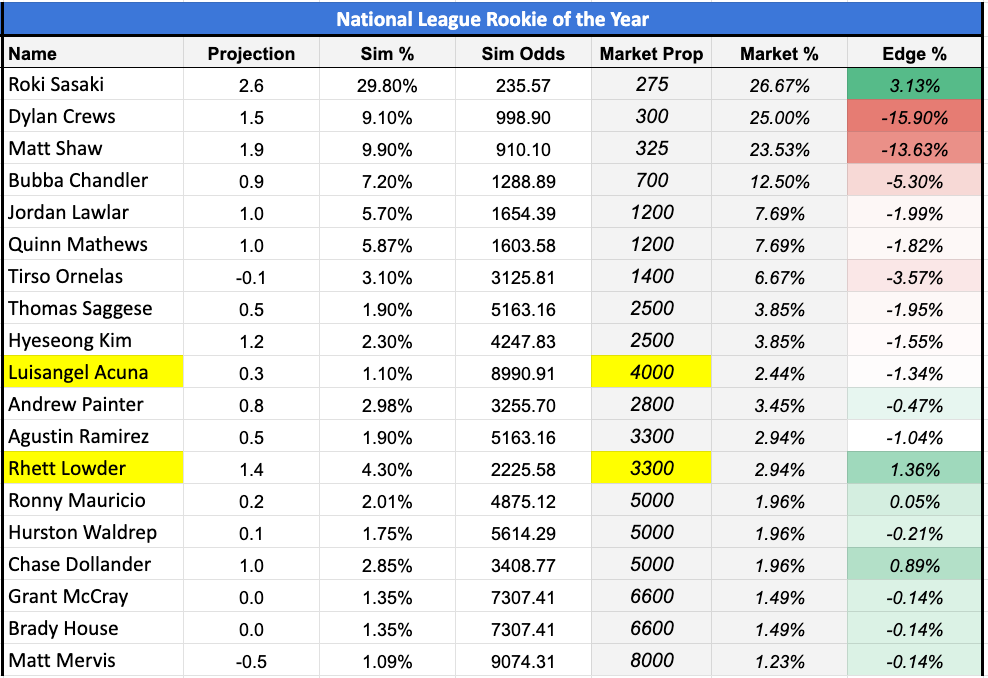
Roki Sasaki stands out in the NL market as the leading candidate to generate the highest WAR, and it's not really close. His short odds reflect this, and the simulation couldn't help but to generate his chance of winning the award near 30% of the time, which is higher than his market price +275 (26%) suggests.
Although there is value here, this is just too low of a price for me to wager in a season-long award, especially since there is such a high correlation to last season when the Dodgers' Yoshinobu Yamamoto was listed at similar odds, and was hampered by making only 18 starts. You can't project injuries, but at this price, the risk is not worth the squeeze.
Rhett Lowder (+3300): Lowder will have a delayed start to his season as he's dealing with arm soreness, but should be fully up and running by May. He's the Reds' #2 pitching prospect, but is the most big league ready after fine-tuning his pro capabilities over the past season and a half in the minors. Given the Reds' need for another electric arm in their rotation, Lowder is a likely candidate to join the club mid-season, where he is likely to rack up WAR in a pivotal role.
Luisangel Acuna (+4000): Acuna got a taste of big league action in 2o24 and shined to the tune of a 166 wRC+ (small sample). He likely won't continue that pace, but it does seem likely he gets a ton of play time, on a strong lineup, hitting at the bottom where he's proven to do damage. He doesn't fit the "exciting young pitcher" mold, but I do see a legitimate path for him to generate a ton of WAR as a strong hitter and versatile defender on a team competing for the NL East crown.